Understanding the Rule of Thirds: 5 Powerful Secrets for Instant Success
Table of Contents
Mastering Understanding the Rule of Thirds is the quickest way to upgrade your artwork from simple doodles to professional-looking compositions. It is the secret weapon used by photographers, graphic designers, and renaissance painters alike to instantly grab the viewer’s attention.
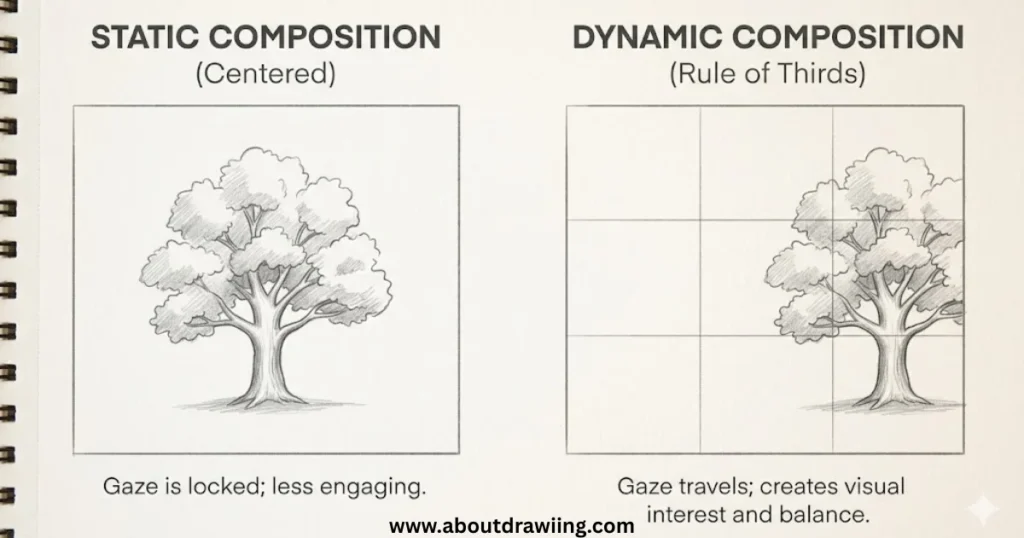
Many beginner artists make the common mistake of placing their main subject dead center in the middle of the frame. While this seems logical, it often creates static, boring, and lifeless art.
If you are frustrated that your drawings lack “wow factor,” the problem isn’t your technique; it’s your layout. Learning Understanding the Rule of Thirds teaches you where to place subjects to create balance, tension, and visual interest.
This ultimate guide will break down this essential concept into five easy, powerful secrets. Let’s unlock the power of professional composition together!
What is Understanding the Rule of Thirds and Why Does it Matter?
The core principle behind Understanding the Rule of Thirds is surprisingly simple yet incredibly powerful. You cannot compose a truly compelling image until you understand how the eye naturally moves across a flat surface.
If you understand the fundamental anatomy of composition, you understand how to guide your viewer’s gaze exactly where you want it to go. This principle is a compositional grid that acts as a blueprint for maximum visual impact.
When you master Understanding the Rule of Thirds, you stop placing elements randomly and start placing them strategically. It forces you to think about the entire canvas, utilizing negative space as effectively as your main subject. This mental shift is the critical dividing line between amateur sketches and serious artwork.
The Core Concept: Grids and Intersection Points
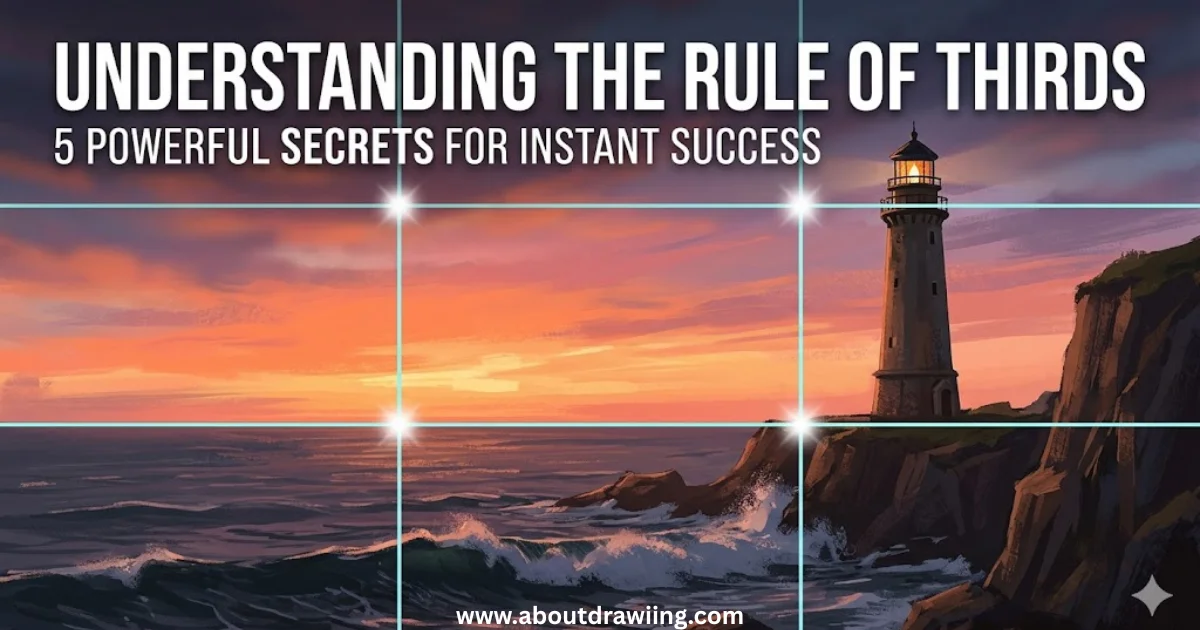
To begin applying Understanding the Rule of Thirds, you must mentally divide your canvas into a grid. Picture two equally spaced horizontal lines crossing two equally spaced vertical lines.
This simple action creates a 3×3 grid consisting of nine perfectly equal rectangles. The four specific locations where these lines cross are known in the art world as the “Power Points” or “intersection points.”
The psychology behind Understanding the Rule of Thirds suggests that the human eye is naturally drawn to these four intersection points rather than the exact center of an image. If you understand how to harness these powerful zones, you control the flow of your entire drawing.
5 Easy Secrets to Apply Understanding the Rule of Thirds in Your Art
Now that you possess a strong understanding of the underlying theory, it is time to put it into practical, actionable practice.
Here are five powerful secrets for instantly applying Understanding the Rule of Thirds to your very next creative project. Mastering these concepts will fundamentally change the way you compose every single image from this day forward.
Secret 1: Off-Center the Focal Point
The first and most important secret to master is avoiding the center at all costs. When you align your main subject—whether it is a portrait model, a majestic tree, or a dynamic action hero—on one of the vertical grid lines, you instantly create a more exciting image. By placing your subject off-center, you force the viewer’s eye to actively journey across the composition, making the entire piece feel significantly more engaging.
Secret 2: Balance with Negative Space
Once you place your main focal point on a Power Point, you must understand how to balance it using the remaining “negative space.” If your subject is positioned on the right vertical third, utilize the large left third for background context, subtle details, or purely blank space to provide a necessary visual rest. Failing to balance that off-center subject can lead to Understanding the Rule of Thirds backfiring, resulting in an image that feels lopsided or unfinished.
Secret 3: Using Power Points for Small Details
If your drawing is incredibly complex with multiple elements, use the intersection points for secondary details. In a sprawling landscape, place a tiny distant house on the lower-right Power Point, while aligning the primary mountain peak on the left vertical line. Utilizing all four points strategically ensures that the viewer’s gaze travels fluidly throughout the entire piece, discovering new, delightful secrets you have cleverly hidden.
Secret 4: Breaking the Rule intentionally
A massive secret that many advanced artists understand is that Understanding the Rule of Thirds is a guideline, not an unbreakable law. Once you confidently understand the concept of power points and grid lines, you can intentionally break them for dramatic effect. For instance, a rigid, stark, perfectly symmetrical subject (like a royal portrait or a classical building) should be centered to emphasize formality and power. You must know the rule before you can effectively break it.
Secret 5: Composition vs. Cropping
If you struggle to understand how to apply the grid while you draw, utilize the power of digital cropping tools. Digital art software like Photoshop, Procreate, or Clip Studio Paint all offer mandatory crop tools that automatically overlay a perfect 3×3 grid. Practice applying this concept during the “thumbnail sketching” phase of your creation. Sketching small variations allows you to visualize multiple composition options efficiently before committing to a final, large-scale piece.
Final Thoughts on Mastering Composition
You now possess the foundational blueprint for composing truly powerful and engaging artwork. Remember that breaking the “center” habit requires consistent, dedicated practice.
Keep your composition grid in mind during the thumbnail sketching phase of every drawing. Over time, Understanding the Rule of Thirds will become second nature, and you will begin seeing grids naturally on everything from empty landscapes to complex still-life setups.
Composition is the invisible infrastructure that makes or breaks an artwork. Master the geometry of these nine rectangles, stay patient with your progress, and deeply enjoy the exciting transformation as your drawings instantly become more dynamic and professional!