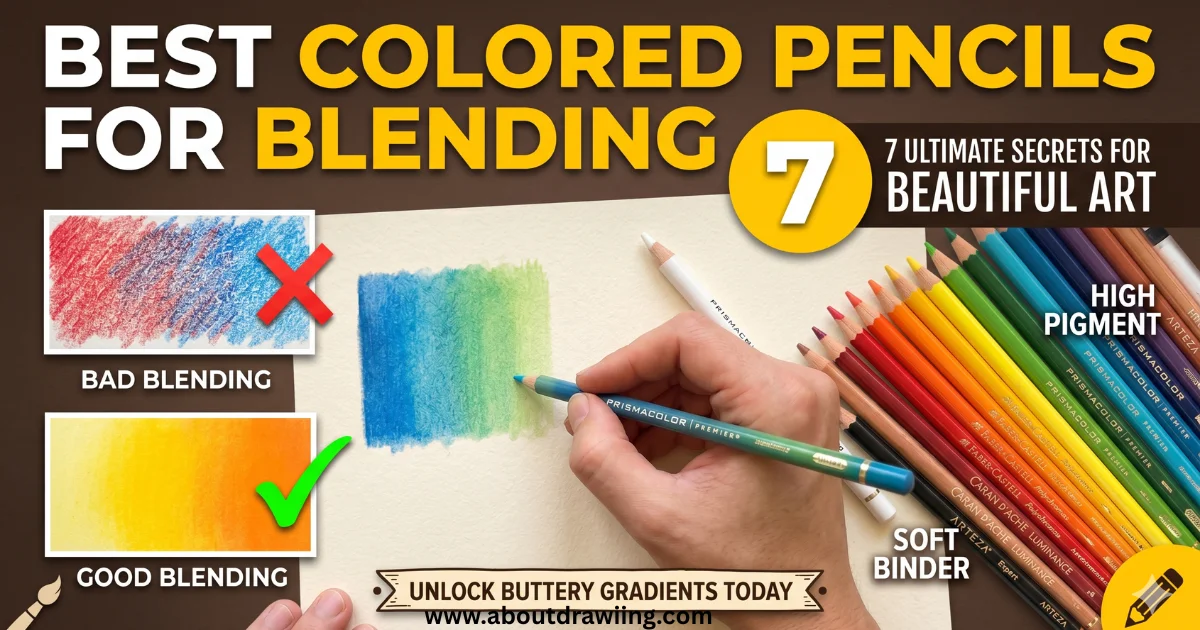
Best Colored Pencils for Blending: 7 Ultimate Secrets for Beautiful Art
Table of Contents
Finding the best colored pencils for blending can completely transform your artwork from flat, lifeless sketches into vibrant, professional masterpieces. Every beginner eventually hits a wall where their colors look scratchy and refuse to mix properly.
If you are frustrated with harsh lines and uneven shading, the problem is likely your art supplies, not your skill level. Cheap, student-grade pencils lack the necessary pigment and soft binders required for smooth color transitions.
To achieve that rich, painted look, you need tools designed specifically for layering. This ultimate guide will reveal the absolute top choices on the market today.
By the end of this article, you will know exactly which sets are the best colored pencils for blending. Let’s dive into the ultimate secrets of achieving perfect, buttery gradients in your sketchbook!
Why Finding the Best Colored Pencils for Blending is Crucial
Many beginners make the painful mistake of buying the cheapest large set of colored pencils they can find. While this saves money initially, it leads to massive frustration when trying to execute advanced techniques.
Standard school pencils have hard, brittle cores filled with fillers rather than pure pigment. When you try to push the colors together, they simply scratch the paper’s surface.
The best colored pencils for blending contain high ratios of high-quality pigment bound together by soft wax or premium oil. This unique chemical composition allows the colors to literally melt into one another.
When you use the right tools, you can create infinite new shades just by overlapping your primary colors. This means a high-quality set of 24 pencils is far more valuable than a cheap set of 100.
Secret 1: Understand Wax-Based vs. Oil-Based Cores
Before purchasing your next set, you must understand the crucial difference between wax-based and oil-based cores. Both types have distinct advantages when looking for the best colored pencils for blending.
Wax-based pencils are incredibly soft and lay down heavy, opaque color very quickly. They are generally considered the easiest option for beginners who want fast, buttery blends without applying too much pressure.
However, heavily layered wax pencils can occasionally suffer from “wax bloom,” a cloudy white film that appears over dark colors. You can easily wipe this away with a soft cloth, but it is something to keep in mind.
Oil-based pencils have a slightly harder core and hold a perfectly sharp point for much longer. While they require a bit more patience to layer, they never produce wax bloom and offer incredible, translucent blending capabilities.
Secret 2: Prismacolor Premier (The Reigning Champion)
If you ask any professional artist what the best colored pencils for blending are, Prismacolor Premier will almost always be their first answer. These iconic pencils are famous for their incredibly soft, highly pigmented wax cores.
Because the core is so soft, Prismacolors lay down rich, vibrant color with almost zero effort. You can easily push different shades together to create flawless, seamless gradients.
They are absolutely perfect for coloring books, realistic portraits, and rich botanical illustrations. The white Prismacolor pencil is especially famous for its ability to flawlessly blend other colors together on the page.
The only downside to their extreme softness is that they require frequent sharpening and can break if dropped. Despite this, they remain the ultimate gold standard for smooth, buttery art.
Secret 3: Faber-Castell Polychromos (The Detail Master)
For artists who prefer oil-based cores, the Faber-Castell Polychromos are heavily regarded as the absolute best colored pencils for blending. They are a premium, professional-grade product manufactured in Germany.
Unlike wax pencils, Polychromos have a delightfully firm core that resists breaking and holds a sharp point for intricate details. This makes them perfect for drawing fine hair, fur, or precise architectural lines.
Blending with Polychromos requires a slightly different, more patient approach than Prismacolors. You achieve smooth transitions by building up many light, highly translucent layers over time.
Because they are oil-based, you will never have to worry about the dreaded wax bloom ruining your dark shadows. They are a brilliant, high-quality investment for serious artists looking to elevate their craft.
Secret 4: Caran d’Ache Luminance (The Luxury Choice)
If budget is not a concern and you want the absolute highest quality available, Caran d’Ache Luminance pencils are legendary. Many fine artists consider these the absolute best colored pencils for blending ever created.
Manufactured in Switzerland, these wax-based pencils feature the highest possible lightfastness ratings. This means your vibrant colors will not fade or shift over time when exposed to sunlight.
The blending capability of Luminance pencils is nothing short of breathtaking. The colors mix so effortlessly that the final result often looks exactly like an oil painting rather than a pencil drawing.
They are undeniably expensive, but the buttery texture and intense pigment payoff make them worth every single penny. They are the ultimate luxury tool for professional gallery artists and ambitious beginners alike.
Secret 5: Arteza Expert (The Best Budget Option)
We understand that dropping hundreds of dollars on art supplies is not realistic for everyone. If you are on a strict budget, the Arteza Expert line offers some of the best colored pencils for blending in their price bracket.
Arteza has completely disrupted the art supply market by offering highly pigmented, wax-based pencils at a fraction of the cost of premium brands. They lay down color smoothly and blend together beautifully.
While they might not have the extreme lightfastness of Caran d’Ache, they are absolutely perfect for sketchbook practice and digital printables. Their vibrant color selection makes them incredibly fun to use.
If you are a beginner looking to upgrade from cheap school supplies without breaking the bank, Arteza is the perfect stepping stone. They provide a massive leap in quality for a highly affordable price.
Secret 6: Master The Burnishing Technique
Even if you buy the absolute best colored pencils for blending, you still need to know the proper techniques to use them effectively. The most essential method every beginner must learn is called “burnishing.”
Burnishing is the process of applying heavy pressure with a light-colored pencil over previously drawn layers. This intense pressure physically crushes the paper’s tooth, forcing the underlying pigments to mix perfectly together.
Typically, artists use a white pencil or a very light cream color to burnish their gradients. This instantly eliminates any white paper speckles showing through your artwork.
Be careful, however, because once you heavily burnish a section of paper, it becomes very slick and shiny. You will not be able to easily add any more dark layers on top of a burnished area.
Secret 7: Use the Right Paper for Your Pencils
A massive secret that many beginners overlook is that the paper you use is just as important as the pencils. Even the best colored pencils for blending will perform terribly on cheap, perfectly smooth printer paper.
Colored pencils require paper with a slight texture, known in the art world as “tooth.” This microscopic texture acts like a cheese grater, catching and holding the pigment particles as you draw.
If your paper is too smooth, the wax or oil will simply slide around without sticking. If the paper is too rough, like heavy watercolor paper, your drawings will look incredibly grainy and speckled.
Look for sketchbooks specifically labeled for “mixed media” or “dry media” with a medium surface texture. Toned tan or gray paper is also incredibly popular because it instantly makes your lighter colors pop off the page.
Exploring Alternative Blending Methods
Burnishing is not the only way to achieve flawless transitions. When working with the best colored pencils for blending, many artists utilize specialized colorless blender pencils.
A colorless blender is simply a pencil core made entirely of the wax binder with zero pigment added. It allows you to aggressively mash colors together without lightening the overall hue of your drawing.
Another highly popular professional technique involves using odorless mineral spirits or specific blending solvents. By lightly brushing these liquid solvents over your pencil strokes, the wax physically melts and spreads like watercolor paint.
Using solvents allows you to achieve completely seamless, painterly backgrounds incredibly fast. It is a highly satisfying technique that instantly elevates your colored pencil artwork to a breathtaking new level.
Final Thoughts on Elevating Your Art
You now possess the ultimate knowledge required to choose the absolutely best colored pencils for blending for your specific artistic needs. Whether you choose the buttery Prismacolors or the detailed Polychromos, upgrading your tools will change everything.
Remember that while great art supplies remove frustrating technical barriers, they do not replace consistent, dedicated practice. Take the time to create small color swatches and test your blending gradients before applying them to a final drawing.
Embrace the relaxing, meditative process of slowly building up your beautiful, vibrant layers. With the right highly pigmented pencils in your hand and the proper blending techniques, there are absolutely no limits to what you can create!